2026 / GUANGZHOU · 广州
Bali Island: Art and the World Beyond the Rainforest巴厘岛:雨林外的艺术与世界

PARTICIPATING ARTISTS参展艺术家
- Fan Chang Tien
- Chen Wen Hsi
- Gilang Propagila
- Guan Shanyue
- Heri Dono
- Huang Dufeng
- Huang Yao
- Ines Katamso
- John Clang
- Koh Nguang How
- Luo Ming
- Robert Zhao Renhui
- Tan Kwank Liang
- Tay Mo-Leong
- Rirkrit Tiravanija
- See Cheen Tee
- The Artist Village (TAV)
- Wang Lanruo
- Xu Qigao
- Yong Mun Sen
SECOND PAN-SOUTHEAST ASIA TRIENNIAL第二届泛东南亚三年展
Bali Island: Art and the World Beyond the Rainforest moves beyond exoticized "tropical" imagery to interrogate the visual construction of Southeast Asia. Using "Bali"—a quintessential locus in modern art history—as a point of departure, the exhibition deconstructs stereotypical tropes to unpack the profound cultural shifts underpinning global perceptions of the region.
Far more than a scenic destination, Bali has functioned as a pivotal hub for global artistic exchange since the early 20th century. By tracing artistic expeditions to Bali and Southeast Asia between the 1930s and 1950s, the exhibition maps a network of lived experience and aesthetic influence:
1930s:
Mexican artist Miguel Covarrubias distilled Balinese life into sophisticated visual symbols that brought the island to global aesthetic attention.
1940s:
Chinese masters Guan Shanyue and Wang Lanruo embarked on sketching trips across the region, employing Eastern brushwork to record the "Nanyang" (Southern Seas) and marking a crucial "Southward" movement of reform in modern Chinese art.
1950s:
Singapore-based artists Chen Wen Hsi, Cheong Soo Pieng, Chen Chong Swee, and Liu Kang traveled to Bali in 1952. Their works laid the foundation for the "Nanyang Style," sowing the seeds for a distinct regional cultural identity.
While Bali serves as the manifest nexus for these Southeast Asian artistic symbols and imagery, the exhibition also traces an underlying historical thread. The intrinsic links between these expeditions converge in Shanghai. En route to Bali in the early 1930s, Covarrubias made five stopovers in the port city of Shanghai, traveling extensively across China and building deep friendships with local artists. Through these interactions and his presence at the Shanghai Art Academy, he left a lasting impact on the pioneers of modern Chinese design and cartoons. Wang Lanruo and the four 1950s Singaporean masters were also alumni, underscoring the institution's role as a vital intellectual crossroads. Curator Hu Chao has confirmed that Chinese artist Luo Ming (himself a Shanghai Art Academy graduate) participated in both the 1940s and 1950s expeditions. This discovery proves a fluid, transnational network of artists who collectively drove the dissemination of modern art across Asia. These cross-cultural artists became bridges connecting China, Southeast Asia, and the Americas. Their practices demonstrate that modernist dissemination was not a unidirectional Western output, but a global resonance involving reciprocal interactions.
Spanning a century, the exhibition features three sections—"The Establishment of Visual Symbols," "The Transformation of Symbols," and "Contemporary Reconstruction"—placing historical documents and contemporary works in dialogue. Nearly half of the space is dedicated to contemporary Southeast Asian art, exploring how today’s artists navigate indigenous identity atop inherited symbols. Selected works by See Cheen Tee reflect a transition from Social Realism to a style reflecting nation-building. Malaysian artist Tay Mo-Leong transformed batik motifs into abstract expression. Indonesian master Heri Dono utilizes Wayang (shadow puppetry) to challenge historical narratives, while Gilang Propagila’s print posters showcase lively art activism in Indonesia. Rirkrit Tiravanija’s "bamboo cage" installation mimics high-rise towers.
As a pioneer of performance art, Koh Nguang How presents a provocative inquiry via his work Why There Is No Goose Meat in Singapore? Furthermore, John Clang and Tan Kwank Liang depict the reality of the local "heartlanders," while Ines Katamso and Robert Zhao Renhui present installations discussing the links between humanity and nature.
The exhibition's core vision is to demonstrate that during the rise of modernism, the Global South had already established profound reciprocal interactions. By positioning Southeast Asia as a dynamic crossroads, this project offers a new lens to understand the artistic resonance between China and the region, re-evaluating modern Chinese art as an integral part of the Global South’s shared modernity.
本展以“巴厘岛”这一现代艺术史中极具代表性的图像符号为起点,梳理出一张彼此交织的现实生活网络与艺术影响脉络,特别聚焦于以下三个关键历史时期:
1930年代:
墨西哥艺术家珂佛罗皮斯以绘画与文字将巴厘岛的椰林、渔村与传统舞姿提炼为异域风情符号,首次将该岛推向全球审美视野。
1940年代:
以关山月、王兰若等为代表的中国艺术家展开“南洋写生”(1947年),以东方水墨的独特视角记录东南亚的自然与人文风貌,开启了中国现代美术史中重要的“南向”实践。
1950年代:
随着二战后东南亚各国相继独立,移居新加坡的华人画家陈文希、钟泗滨、陈宗瑞、刘抗等人赴巴厘岛创作,大批油画作品奠定了“南洋风格”的基础,为区域文化认同埋下了种子。
这些跨文化行走的艺术家,从各自的文化背景与世界经验中汲取营养,成为连接中国、东南亚与美洲的艺术桥梁。他们的实践表明:现代主义艺术的传播并非由西方中心向非西方的单向输出。相反,这是一场由多方参与、多种形式互动的全球共振。
上述跨越时空的实践,既是本展览的历史锚点,也是贯穿百年的艺术伏线。展览通过"视觉符号的建立""符号的转化"与"当代的重新建构"三大板块,将历史文献与当代作品置于同一空间,展开多维度的叙事对话。
在此基础上,展览的核心愿景是呈现一个无论在历史还是当下,都与世界紧密联系的东南亚。通过多媒介作品的并置,我们力求超越"热带雨林"的表面符号,深入其背后的人文与社会内涵。同时,展览也期待为广州观众了解岭南地区乃至中国与东南亚的艺术对话提供新视角,并为理解中国现代艺术进程及与"全球南方"的联系提供一份注脚。

展览板块
展览核心板块与作品详述
展览分为“视觉符号的建立”“符号的转化”与“当代的重新建构”三大板块,将历史文献与当代作品置于同一空间,展开多维度的叙事对话:
第一部分:视觉符号的建立——珂佛罗皮斯与全球视野
本部分介绍了墨西哥艺术家珂佛罗皮斯如何在20世纪30年代通过其绘画与书籍向世界展示巴厘岛的独特魅力。
珂佛罗皮斯(Miguel Covarrubias): 墨西哥著名艺术家,上个世纪二三十年代在纽约赢得卓著声誉,深度参与纽约哈莱姆文艺复兴运动(Harlem Renaissance),把非洲裔文化推向社会主流讨论空间。他也是著名杂志《纽约客》和《名利场》的主要封面插图师,其作品影响到当时的上海。他去往巴厘岛途中三次访问中国,和张光宇、叶浅予等人有过密切交往,对中国漫画和设计产生过重要影响之外,他对中国艺术和文化传统产生了浓厚兴趣,包括后来为《水浒传》的第一个英文版本绘制了30幅插图。珂佛罗皮斯的作品将巴厘岛的热带风土人情提炼为具有异国情调的视觉符号,诸如椰林胶木、海岛渔村、舞姿婆娑等元素,成为全球观众对巴厘岛乃至东南亚的常见象征。
第二部分:亚洲视野下的南洋画事
本部分聚焦于中国艺术家,特别是关山月等人于1947年前后的“南洋写生”的作品展现,反映了中国艺术家如何观察与记录东南亚的自然景观与人文风貌。
关山月、王兰若与“向南看”的实践: 他们于1947年前后的“南洋写生”是中国艺术家在当时“向南看”的重要实践,是艺术家们在西北西南边疆写生游之后,中国艺术家不断扩展创作视野,反映了艺术家们思考民族文化艺术特色的重要思潮,也是促成中国艺术届反思中古艺术传统和发展的重要事件。
新加坡先驱画家: 1952年,移居新加坡的华人画家如陈文希、刘抗、钟泗滨、陈宗瑞等四位艺术家前往巴厘岛写生。他们主要以油画创作的作品轰动一时,反映的东南亚热带生活题材,后来也被称为“南洋风”或者“南洋风格”。
人物交集——罗铭: 策展人通过研究发现,关山月、王兰若的1947年东南亚写生,与1952年陈文希、刘抗等人从新加坡去巴厘岛写生,两次行旅中有一个人物交集——著名画家罗铭。这反映出二战前后东南亚华人和中国之间的艺术交流网络。展览也因此特意呈现了罗铭的作品。
第三部分:热带符号的当代拓展
展示来自泰国、新加坡、印尼和马来西亚等地的当代艺术家创作的作品,呈现他们对现代东南亚的视觉表达、想象与理解。
许振第(1928-1996): 新加坡本土成长的第一代艺术家,五十年代毕业于南洋艺术学院。他在五六十年代创作的木刻反映了中国新兴木刻理念在东南亚的现实主义影响,体现了“雨林”中的社会与生活面貌,其多件作品因为记录了新加坡的历史和艺术而被新加坡国家博物馆和国家美术馆收藏。此次也是许振第作品首次在中国公开展出。
里克力·提拉瓦尼(Rirkrit Tiravanija): 泰国艺术家通过传统竹艺的外表,以上海现代化高楼为模拟对象,创作了这组高达7.7米的作品,将东南亚艺术家对当地现代化和都市化进程观察,扩展到了中国以及更为广阔的亚洲地区。
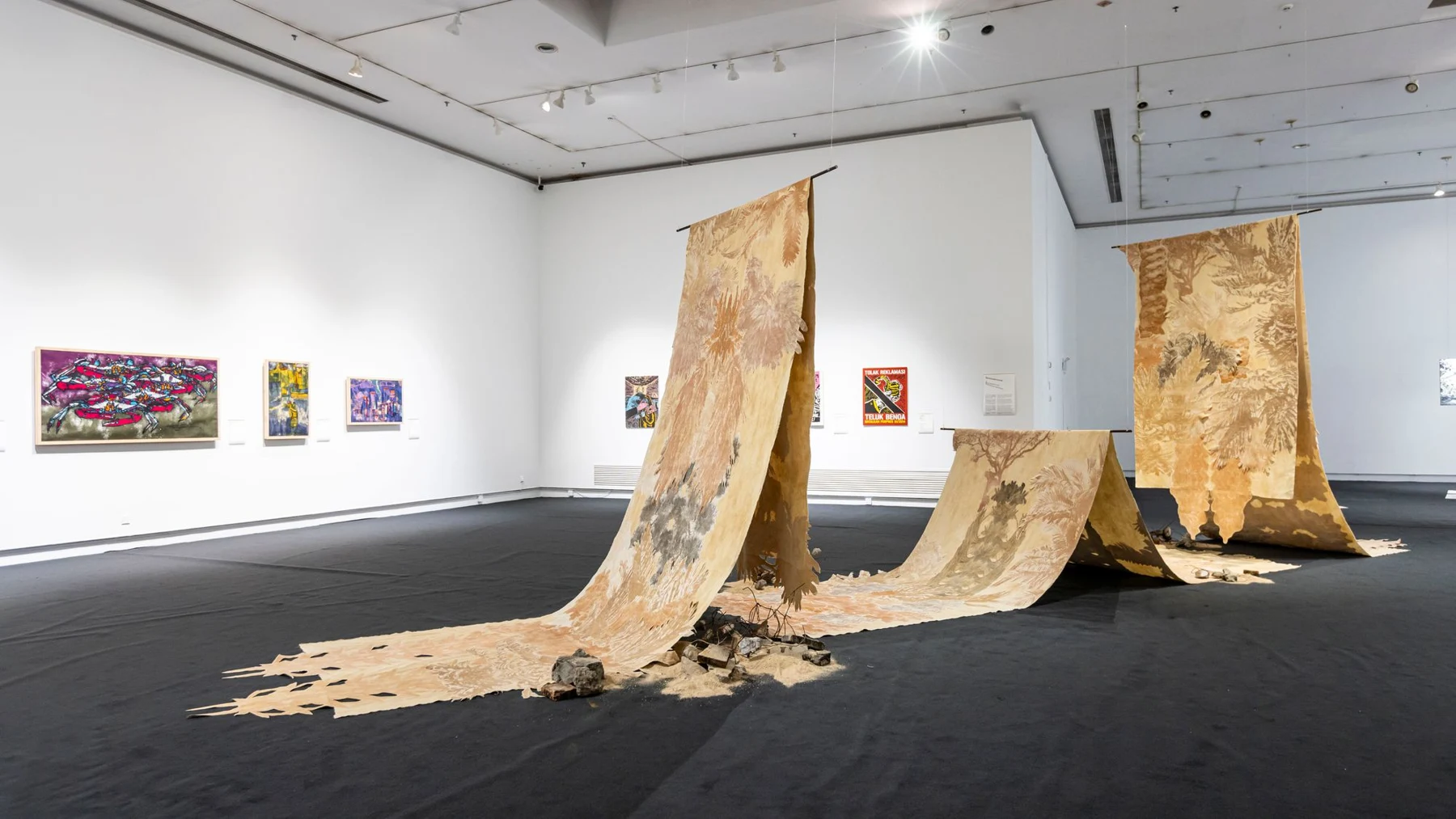
伊内斯·卡塔姆索(Ines Katamso): 常居巴厘岛的艺术家 Ines Katamso 为本次广州展览特意创作了大型装置作品。
该装置源于中国与巴厘岛之间的对话:借鉴了中国传统山水画的精致视觉传统,同时反思了巴厘岛快速变化的环境。巴厘岛曾被视为神圣的岛屿,而如今正受到大众旅游、无节制建设和生态侵蚀的标记。
作品以悬挂式纺织品的形式呈现,长长的织物勾勒出山脉的轮廓。其独特之处在于,织物所使用的颜料完全提取自巴厘岛各处收集的建筑废墟:包括砖块、混凝土、水泥、石头和铁锈,这些都是因过度建设而堆积在街道上的废物。
这些工业颜料与织物上印制的巴厘岛热带丛林图案形成了鲜明对比,揭示了开发压力如何侵入并改变岛上最原始的生态系统。作品以“城市遗骸”叩问商品主义扩张带来的生态挑战,邀请中国观众思考文化生态系统如何被商品化,并呼吁公众意识到保护现存自然景观的重要性。
赵仁辉(Robert Zhao Renhui): 新加坡艺术家。他创作的系列多媒体作品《新加坡,古老的树》,记录热带树木和当地人生活的密切联系,并将当下的社会生活和欧洲殖民者发现东南亚的历史线连接,从而讲述了热带环境在今天的本土身份意义。这组摄影被新加坡国家博物馆以个展形式展出,庆祝新加坡成立五十周年。本次展览精选了这一系列中的部分作品。
赫利·多诺(Heri Dono): 1960年出生于雅加达,是印尼当代最富有国际声誉的艺术家之一。他先后参加过300多个国际双年展,曾代表印尼参加威尼斯双年展,作品被古根海姆博物馆、新加坡美术馆等机构收藏。其创作以将爪哇皮影戏(wayang)等传统民间艺术与当代图像巧妙融合而闻名。通过狂野的变形、自由的幻想以及对漫画、动画的深刻理解,多诺的作品旨在打破西方艺术的主流叙事,呈现印尼本土文化的思考。本次展览展出了他的大型绘画《飞翔的天使II》。
戴懋龙(Tay Mo-Leong): 马来西亚艺术家。东南亚一些艺术家从五十年代起开始尝试运用传统蜡染工艺进行艺术创作,马来西亚艺术家在这个方面做出了较为显著的探索,并由此形成了蜡染艺术作为马来西亚本土艺术传统的叙事。本次展览展出5件戴懋龙的蜡染作品,包括抽象风格的作品,反映了蜡染作为艺术形式的多种表现力。东南亚蜡染现代艺术作品在国内较少展出,本次展览将展现蜡染工艺成为艺术创作的独特魅力。
许元豪(Koh Nguang How): 新加坡“艺术家村”(The Artists Village,简称 TAV)创始人之一。TAV是新加坡最早的艺术社群之一,在将装置艺术和行为艺术引入新加坡当代艺术界方面发挥了关键作用。许元豪曾记录了领军人物唐大雾埋葬一只鹅的行为艺术作品,本次展览中,许元豪运用此前未曾发表过的照片文献,为本展览特别创作了摄影装置作品《新加坡为什么吃不到鹅肉》。